A Series of Unwarranted Events
(2018)

Untitled (So he mixed arsenic with half the flour and a raging thirst was created), archival inkjet print, 80 X 100 CM.

Untitled (The best means, of caring for, and dealing with them in the future), archival inkjet print, 80 X 100 CM.
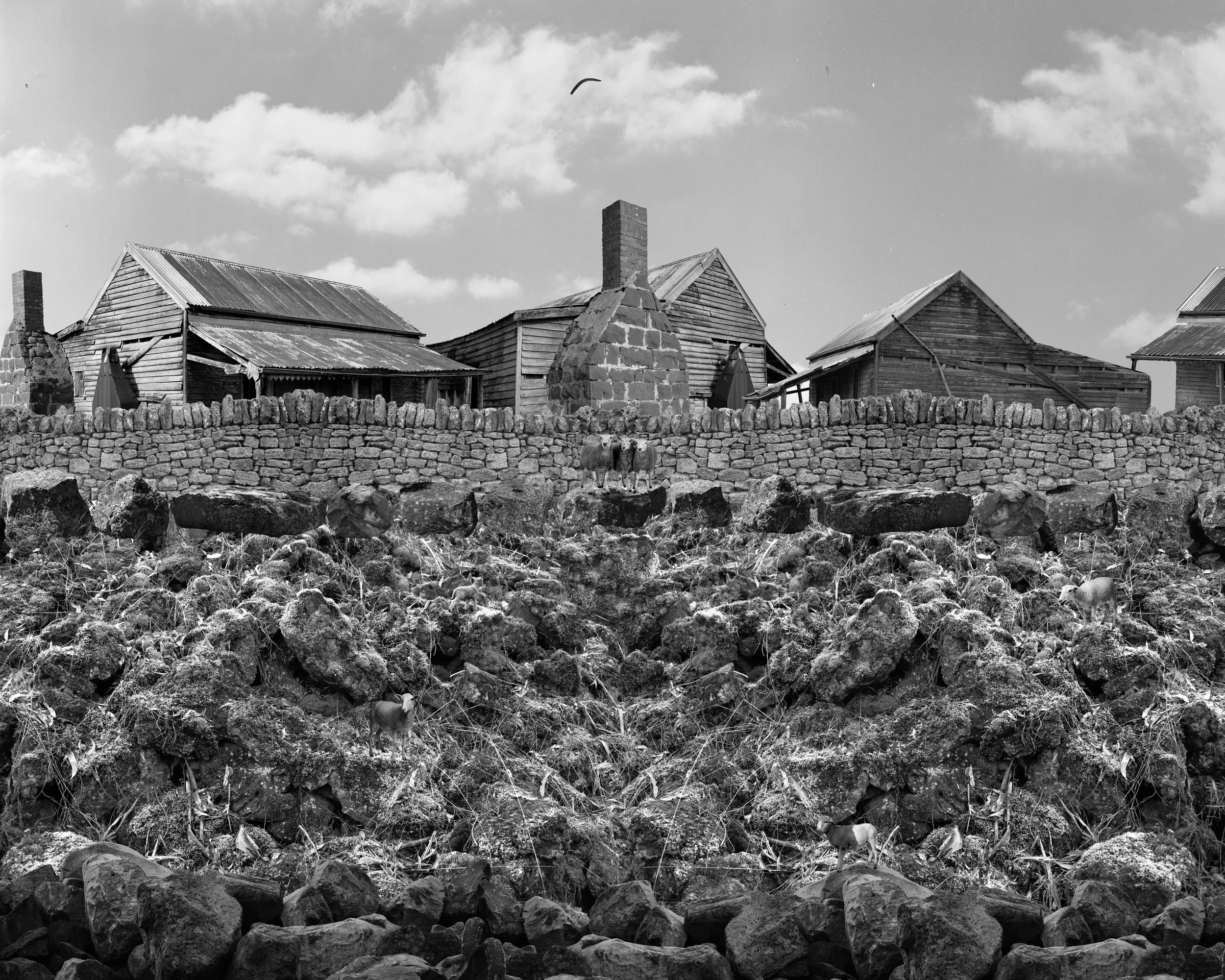
Untitled (The theft of the White men's sheep), archival inkjet print, 80 X 100 CM.

Untitled (The circumstances are that a whale had come on shore), archival inkjet print, 67 X 67 CM.
A Series of Unwarranted Events shares four stories of frontier violence faced by the Gunditjmara people, highlighting the brutal realities of the invasion and colonisation of their land. The European invasion of western Victoria was marked by violence, including countless killings and massacres of Aboriginal people. Stories of skulls nailed to doorways and rivers running red serve as haunting reminders of an unforgivable past, standing as witnesses to the strength and resilience of the Gunditjmara people.
The collaged landscapes deliberately avoid showing the actual sites of violence. They remove all signs of physical trauma, focusing instead on the silence and emptiness of a scarred land and a painful history that demands acknowledgement. The work honours the resilience that endures, even as the land and collective memory bear the marks of past wounds.
“I have heard tales told, and some things I have seen that would form as dark a page as ever you could read in the book of history — but I thank God I have never participated in them — If I could remedy these things, I would speak loudly though it would cost me all I am worth in the world, but as I cannot I will keep aloof and know nothing, and say nothing.”
— Henry Howard Meyrick, Journal dated 1840 to 1847

The Convincing Ground massacre took place on Allestree breach between a group of sailors and a Gunditjmara clan in 1833, however the exact date is uncertain and some people consider the Convincing Ground massacre a myth. Portland shore served the Gunditjmara people as a place of ocean abundance. The circumstances are that a whale had come on shore, and a Gunditjmara clan went to collect the meat as they had for thousands of years. A group of sailors protested they had ownership of the whale as Portland belonged to them now, and so a conflict started. Untitled (The circumstances are that a whale had come on shore) speaks to the murders of the Kilcarer Gunditj clan over the ownership of whale meat.

The Murdering Flat massacre occurred in 1840 on Wannon River, killing dozens of Gunditjmara people. A hut keeper employed by the Henty brothers noticed that his monthly delivery of flour would often be the victim of theft at the hands of the local Aboriginal people. The Gunditjmara people would wait until the hutkeeper left his station and rob his hut of flour. The hut keeper became frustrated by the raids, so he mixed arsenic into the bags of flour. Untitled (So he mixed arsenic with half the flour, and a raging thirst was created) tells the story of the dozens of lost lives of the Gunditjmara people who had been poisoned making flour cakes down by Wannon River. The arsenic created an extreme thirst, forcing them to rush down to the river, where they drowned from the effects of the arsenic poisoning.

The Eumeralla Wars began on Gunditjmara Country in 1834 and continued through to 1849. During this time of frontier violence, the Gunditjmara used the large expanse of volcanic hills as a base from which they would launch their attacks and revenge against the colonisers who dispossessed them. The Eumeralla Wars witnessed countless unprovoked and redundant killings upon the Gunditjmara, too often simply in the name of eliminating the Aboriginals from the Colonist view. Untitled (The theft of the White men's sheep) communicates stories of how the Gunditjmara would often capture livestock from the colonists’ settlements and return to camp through rocky terrain, deeming the colonisers incapable of retrieving their stock without injury.

The Lake Condah Aboriginal Mission Station was built in 1867 under the leadership of the Church of England. The Church of England saw the mission as a means to ‘civilise’ the Gunditjmara people through the compulsion of Western education and Christianity. Its occupants were subject to strict regimes such as twice-daily prayers, church services and religious studies, all in the hopes of a successful assimilation. The missions’ governance executed brutal policies by denying work permits to the residents, providing rations as rewards rather than a right, and operating as an institution to house stolen children.

A Series of Unwarranted Events, Museum of Contemporary Art Australia, Australia.